The Catch-22 of Migraine Tracking
Anyone who manages chronic migraines is deeply familiar with the central paradox of tracking the disease. Neurologists and headache specialists insist that you maintain detailed logs of your attacks: timestamps, pain severity, associated symptoms, medication dosages, and suspected triggers. This data is absolutely essential for verifying treatment efficacy and recognizing patterns.
However, achieving high-fidelity tracking requires documenting the attack while it is actually happening. This presents a massive, often insurmountable problem: Photophobia.
During a severe migraine attack, extreme sensitivity to light is one of the most common and debilitating symptoms. The mere thought of unlocking a smartphone, staring at a glaring, brightly-lit app interface, and attempting to read small text to tap checkboxes is agonizing. It exacerbates the pain, worsens nausea, and directly violates the biological instinct to retreat to a completely dark, silent room. As a result, patients avoid logging altogether, waiting until days later to record an attack via unreliable memory. The data is lost.
This catch-22 has plagued migraine management for decades. But today, the integration of Artificial Intelligence and voice logging is fundamentally solving the problem.
What is Voice Logging?
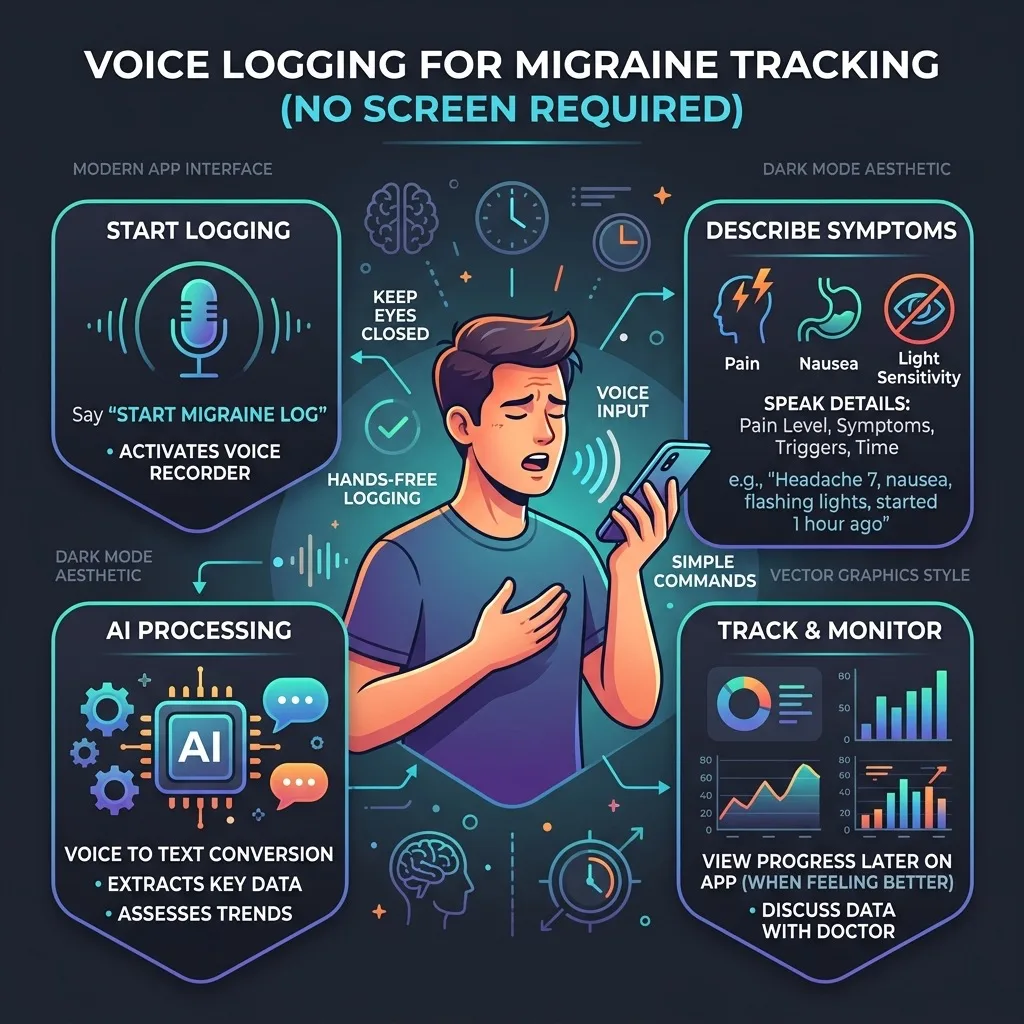
Voice logging is the ability to record, analyze, and categorize complex medical data using natural spoken language. Instead of navigating through multiple drop-down menus and tap interactions on a screen, a user simply speaks to their device.
In the context of the Migraine Trail app, voice logging allows a user to invoke the application and provide an unstructured verbal diary entry. The underlying AI engine, powered by advanced Large Language Models, instantly transcribes the audio, understands the clinical context, and automatically extracts the structured data points required by a neurologist.
How Voice Logging Changes the Game
1. Hands-Free, Eyes-Closed Tracking
The most immediate benefit of voice logging is compliance with the "Dark Room First" approach to migraine management. You can lie in bed with an ice pack covering your eyes, in total darkness, and still construct a perfect clinical log. All it takes is a single tap (or a Siri/Google Assistant shortcut) to begin recording. You can say:
"I started getting an aura about thirty minutes ago, and right now the pain is a throbbing 8 out of 10 on my right temple. I feel very nauseous. I just took my Nurtec and a dose of Zofran."
Without ever looking at a screen, the app logs the timestamps, scores the severity at 8/10, tags the symptoms (Aura, Nausea, Throbbing Pain, Right-Sided), and records the specific acute medications taken.
2. Capturing the Nuance of the Moment
When forced to use standard app checkboxes, nuance is lost. A checkbox for "Visual Disturbances" doesn't capture the difference between a zigzag line and total loss of peripheral vision. Voice logging encourages natural expression. Because an AI reads the transcription, it can capture subtleties regarding the quality of pain or the emotional distress surrounding the attack that standard UI forms miss.
3. Immediate Cognitive Offloading
During the neurological storm of a migraine, cognitive function—often called "brain fog"—is severely impaired. Trying to remember if you took your preventative medication at 8 AM or 10 AM, or trying to do the math on how many hours have passed since your last triptan dose, is stressful and difficult. Voice logging offloads this cognitive burden. You simply speak your reality stream-of-consciousness style, and the AI handles the organization, categorization, and timeline structuring.
4. Overcoming the "Post-Attack Amnesia"
The "postdrome" phase of a migraine (the migraine hangover) often comes with memory impairment and extreme fatigue. If you failed to track the attack during its peak, your chances of recalling the accurate peak pain intensity or the exact minute you took your medication dissipate rapidly. Voice logging ensures the data is captured in real-time, eliminating the reliance on flawed retrospective memory.
The Security and Privacy of Voice Data
A common concern regarding voice-activated health apps is privacy. Given the sensitive nature of medical data, it is critical to use tracking tools that prioritize security. Modern architectures, like the one used by Migraine Trail, ensure that voice recordings are ephemeral. The audio is recorded, encrypted in transit, instantly transcribed and computationally parsed by the AI, and then immediately deleted forever. Only the extracted text and structured data points are permanently stored in your secure journal. The actual recording of your voice is never retained, analyzed for advertising, or shared with third parties.
Reclaiming Your Treatment Strategy
Data is the singular currency used in modern headache medicine. Without it, you cannot optimize your treatments or recognize the environmental triggers causing your pain.
By eliminating the agonizing friction of manual data entry through bright screens, voice logging enables chronic migraine patients to maintain perfect, high-fidelity medical logs regardless of their level of disability during an attack. It represents a monumental leap forward in patient empowerment, allowing you to prioritize the dark room while the AI handles the paperwork.