Stop Guessing. Start Tracking Your Migraine Triggers.
Most people suspect their triggers. Migraine Trail helps you prove them with AI-powered multi-variable analysis.
Triggers rarely act alone. It's the stacking effect: a night of poor sleep combined with a barometric pressure drop and a skipped breakfast. Manual journals can't cross-reference these variables over weeks of time. Migraine Trail does it automatically, every day.
Identify My TriggersFree on iOS · No credit card required
Why Migraine Triggers Are So Hard to Identify
Your brain needs weeks of structured data to find the patterns. Manual guessing almost always gets it wrong.
The Trigger Stacking Problem
Single triggers cause fewer than 15% of migraine attacks. Most require 2 to 3 factors stacking together, like sleep deprivation plus a weather change plus stress. This combination is invisible to manual tracking.
Delayed Triggers Fool You
Many triggers don't cause an attack until 12–24 hours later. By then, you've forgotten what you ate, how you slept, or what the weather was doing. Only consistent logged data reveals these delayed correlations reliably.
Confirmation Bias Misleads You
People tend to confirm triggers they already suspect while missing real ones. An AI trigger tracking app analyzes all logged variables objectively, including factors you'd never think to suspect as a cause.
Every Trigger Category, Tracked Automatically
Migraine Trail logs all major trigger categories alongside every entry, most without any extra steps from you.
Weather & Barometric Pressure
Barometric pressure changes are among the most common migraine triggers, affecting an estimated 50% of sufferers. Migraine Trail automatically logs real-time weather data at your location alongside every entry, so this correlation builds without any manual effort on your part.
- Real-time barometric pressure logged per entry automatically
- Temperature and humidity correlation analysis
- 24-hour advance weather risk alerts for high-risk windows
Sleep, Stress & Daily Habits
Log sleep quality, stress levels, hydration, and physical activity alongside every attack. Migraine Trail cross-references these lifestyle factors against your attack history to surface your most impactful controllable triggers, the ones you can actually do something about.
- Sleep duration and quality correlation over time
- Stress and anxiety level tracking per day
- Hydration and exercise pattern analysis
Food, Caffeine & Alcohol
Note potential dietary triggers in your voice log: caffeine intake, alcohol type, meal timing, or specific foods. Over time, the AI identifies which dietary factors correlate most strongly with your attacks, separating true triggers from suspected ones.
- Caffeine withdrawal and overconsumption pattern detection
- Alcohol type and quantity correlation analysis
- Meal timing and skipped meal pattern tracking
How to Actually Identify Your Migraine Triggers
The science behind why trigger identification requires data, and how to make it manageable.
Migraine trigger identification is one of the most misunderstood aspects of managing the condition. Most people approach it through intuition: "I always get a migraine after red wine" or "stress definitely causes mine." But research consistently shows that self-reported trigger identification without systematic data is unreliable. The same trigger causes an attack only in specific conditions, and those conditions vary from person to person and even attack to attack.
The clinical standard for trigger identification is a minimum of 8 to 12 weeks of structured daily logging, capturing not just attack data but potential preceding factors: sleep, diet, stress, weather, hormonal cycle, medications, and physical activity. When this data is analyzed across all attacks, genuine triggers emerge as statistically significant correlations. Suspected triggers that don't show up in the data can be safely deprioritized, freeing you to focus on what actually matters.
The Difference Between Controllable and Uncontrollable Triggers
Not all triggers are equal from a management standpoint. Weather changes, hormonal fluctuations, and certain medications can't be eliminated, but they can be anticipated. Knowing that barometric pressure drops are a strong trigger for you means you can time preventative medication more precisely when a storm is forecast. Our guide to barometric pressure and migraine prediction explains how this works in practice.
Controllable triggers like sleep schedule irregularities, caffeine intake, dehydration, and skipped meals offer genuine prevention opportunities. Once you know that sleeping fewer than 6 hours consistently precedes attacks, you have actionable information. Once you know that weekend "sleeping in" disrupts your sleep rhythm and triggers Monday migraines, you can adjust. These are the insights that lead to real reductions in attack frequency over time.
Food Triggers: Separating Fact from Myth
Dietary triggers are among the most discussed and most misattributed. Common suspects like chocolate, aged cheese, and red wine are often blamed, but research suggests they may actually be prodrome cravings: foods you eat because an attack is already starting, not true triggers. The only reliable way to tell the difference is systematic tracking over time. Our complete guide to food triggers covers the evidence on common dietary suspects and how to distinguish true triggers from false positives in your own data.
How the AI Trigger Analysis Works
No spreadsheets. No manual analysis. The AI does the work while you just log.
Multi-Variable Correlation
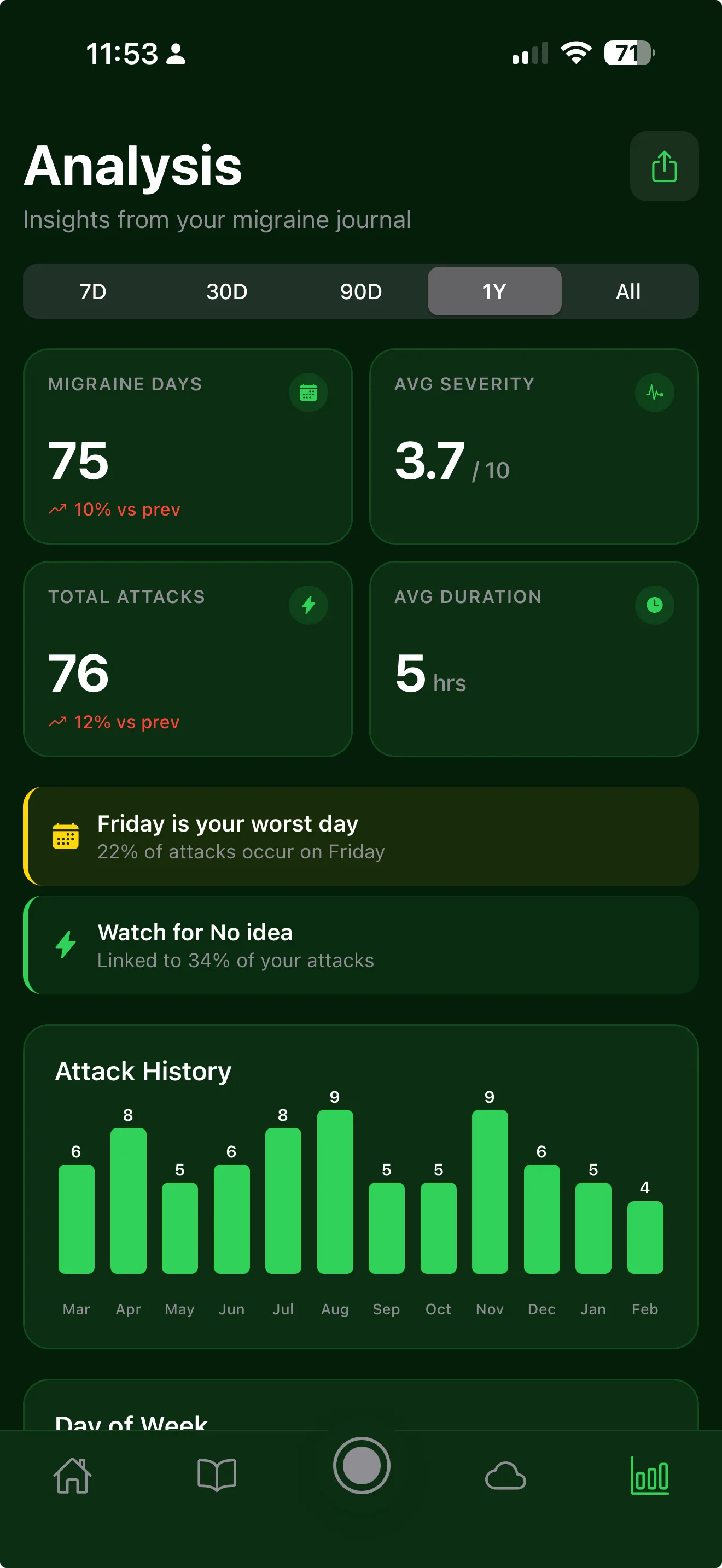
Every entry is cross-referenced against weather, sleep, diet, stress, medication, and symptom data simultaneously, finding the combinations that precede your attacks, not just individual factors.
Confidence-Ranked Triggers
Triggers are ranked by statistical correlation strength. You see which factors have the highest confidence score, so you know exactly where to focus your prevention efforts first.
Measurable Results
Users who identify and modify their top controllable triggers consistently see a meaningful reduction in attack frequency within 3 months of acting on their personal trigger data.
Personalised, Not Generic
There's no universal trigger list. Your trigger profile is built from your own data, specific to your physiology, habits, and environment, not population-level averages.
Trigger Tracking Questions Answered
How long does it take to identify my migraine triggers?
Most people start seeing statistically meaningful trigger patterns after 6 to 8 weeks of consistent daily logging. The AI becomes more confident and specific as your dataset grows. By 3 months, most users have a clear ranked list of their top controllable triggers.
Why is it so hard to identify migraine triggers on your own?
Because triggers rarely act alone. Most attacks require 2 to 3 factors stacking together, like a night of poor sleep combined with a barometric pressure drop and a skipped breakfast. Human memory can't reliably track and cross-reference this many variables over weeks of time. An AI trigger tracking app does this automatically.
What are the most common migraine triggers?
The most commonly reported migraine triggers are: barometric pressure changes (weather), sleep disruption (too little or too much), hormonal changes (menstrual cycle), stress and anxiety, dehydration, skipped meals, caffeine withdrawal or overconsumption, alcohol (especially red wine and beer), bright or flickering lights, and strong smells. Your personal trigger profile may differ, which is why individual tracking matters.
Can I reduce my migraine frequency by tracking triggers?
Yes, for triggers within your control. Users who identify and consistently avoid their top 2 to 3 controllable triggers, such as sleep schedule irregularities, caffeine fluctuations, or dehydration, typically see a meaningful reduction in attack frequency within 2 to 3 months. Environmental triggers like weather can't be avoided, but knowing they're active helps you take preventative medication at the right time.
Find Your Triggers. Take Back Control.
The best app to track migraine triggers is the one that does the analysis for you. Download Migraine Trail free and start building your personal trigger profile today.
Download Free on iOSRelated: Symptom Tracker · Migraine Tracker App