Migraine Tracking with AI. Your Patterns, Identified Automatically
Stop guessing. AI cross-references your attacks against weather, sleep, food, and stress to surface your real triggers.
Traditional migraine diaries collect data. AI migraine tracking turns that data into answers, trigger rankings, attack predictions, and clinical summaries, without you having to analyze a single spreadsheet.
Try AI Tracking FreeFree on iOS · No credit card required
Why Traditional Migraine Tracking Falls Short
Paper diaries and basic apps collect data. They don't analyze it. That gap is where triggers stay hidden.
Human Memory Is Unreliable
Triggers often act 12–24 hours before an attack. By the time you're logging, you've forgotten what you ate, how you slept, or whether the weather changed overnight. Even the most diligent manual tracker can't reliably recall the relevant variables for every attack over months of time.
Manual Analysis Is Impractical
Finding trigger patterns requires cross-referencing dozens of variables, weather, sleep, food, hormones, medications, stress, across all your entries simultaneously. Doing this manually, even with a spreadsheet, takes hours and typically misses multi-variable combinations that only emerge through statistical analysis.
Confirmation Bias Distorts Results
People reliably over-attribute attacks to triggers they already suspect and miss real causes they've never considered. AI analysis is objective, it evaluates every logged variable with equal weight and surfaces correlations that human pattern-matching consistently misses.
Three Ways AI Makes Migraine Tracking Smarter
From the moment you log to the report you share with your doctor, AI works in the background on your behalf.
Natural Speech Becomes Clinical Data
Migraine Trail uses AI to convert voice logs into structured medical records. Speak naturally, describe your pain level, symptoms, medications, and any potential triggers you've noticed, and the AI extracts each data point into the correct category automatically. You never fill in a form. The AI does that work for you.
- Extracts pain scores, symptom categories, and medication names from speech
- Handles natural language, no specific phrasing required
- Works in under 30 seconds from tap to saved entry
AI Identifies Your Personal Trigger Profile
Over time, the AI continuously cross-references your logged entries against all tracked variables, including automatic weather data collected at your location. It surfaces trigger correlations ranked by statistical confidence, distinguishing between high-confidence patterns and tentative signals. The longer you log, the more precise and personalized the analysis becomes.
- Multi-variable correlation across weather, sleep, food, and stress
- Trigger confidence ranking, know what to prioritize
- Delayed trigger detection across 12–48 hour windows
Know Your High-Risk Windows Before They Hit
Your personal trigger profile combined with real-time weather data powers a personalized risk forecast for the next 24–48 hours. When barometric pressure drops, temperature shifts, or other conditions align with your known triggers, the app alerts you, so you can take preventative action before symptoms start rather than treating them after.
- 24–48 hour personalized risk forecasts
- Real-time barometric pressure and weather monitoring
- Alerts calibrated to your specific trigger sensitivities
Why AI Changes What's Possible in Migraine Management
The science of what AI can do for neurological condition tracking, and why it matters.
For decades, migraine management has relied on a fundamentally limited tool: the headache diary. Patients log attacks, sometimes in detail, often inconsistently, and then present that diary to a neurologist once every few months. The neurologist reviews it, looks for patterns, and adjusts treatment accordingly. The information bottleneck in this process is the human pattern recognition step: a busy clinician reviewing a paper diary for 5 minutes simply cannot identify multi-variable trigger combinations across 60 entries the way an algorithm can.
AI migraine tracking doesn't replace the neurologist, it gives them better data to work with. When your doctor receives a clinical summary showing that your attacks have a 73% correlation with barometric pressure drops of more than 8 mbar, occurring most frequently 18–24 hours after the drop, combined with sleep shorter than 6.5 hours, they have actionable, specific information rather than a general sense that "weather and sleep seem to be factors." That specificity changes treatment decisions.
Voice + AI: The Combination That Makes Tracking Sustainable
The two biggest barriers to consistent migraine tracking are logging difficulty during attacks and the burden of analyzing data afterward. AI addresses both. Voice logging eliminates the form-filling problem, you speak naturally for 20 seconds and the AI structures your entry. Pattern analysis eliminates the manual review problem, the AI processes all your entries continuously and surfaces insights as your dataset grows.
The result is a tracking system that's easier to maintain than a paper diary and more analytically powerful than anything a patient could do manually. Users who combine consistent voice logging with AI analysis typically have a clear picture of their top controllable triggers within 8–10 weeks, information that previously took years of trial-and-error (if it emerged at all).
What AI Can and Can't Do for Migraine Prediction
It's worth being clear about what AI prediction means in the context of migraines. Migraine Trail's forecasting is probabilistic, it tells you that conditions aligning with your personal trigger profile are present, which historically precedes your attacks. It does not guarantee an attack will occur. Migraine is a complex neurological condition with genetic components, and no app can predict every attack. What AI can do is meaningfully improve the percentage of attacks you anticipate versus react to, which, for many people, is the difference between effective preventive treatment and perpetual catch-up.
What AI-Powered Tracking Gives You
Beyond logging, what the data actually produces for you over time.
Personalized Trigger Rankings
A confidence-ranked list of your specific triggers, not population averages. Know whether weather, sleep, or caffeine is your top controllable risk factor and act accordingly.
Trend Visibility
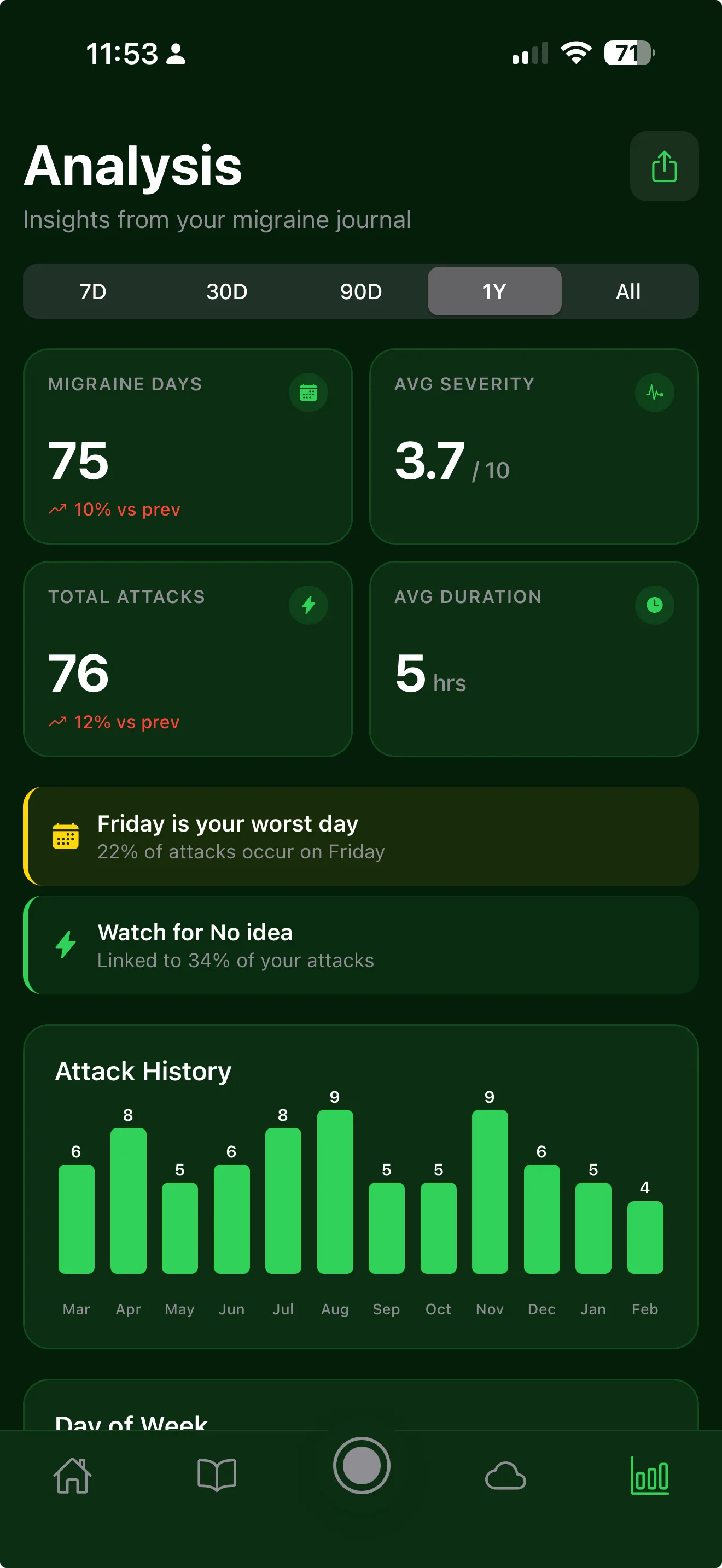
See whether your attack frequency is improving or worsening over time, which medications are working best, and whether lifestyle changes are having an effect, all without building a spreadsheet.
Proactive Risk Alerts
24–48 hour advance warnings when weather and personal trigger conditions align, so you can take preventative medication at the optimal time rather than after symptoms start.
Clinical-Quality Reports
One-tap PDF generation with attack timelines, trigger analysis charts, and medication effectiveness data, everything your neurologist needs, formatted for clinical use.
AI Migraine Tracking Questions Answered
What does AI actually do in a migraine tracking app?
In Migraine Trail, AI performs three main functions. First, it parses voice logs, converting natural speech into structured clinical data (pain scores, symptoms, medications, triggers) without requiring you to fill in forms. Second, it performs continuous multi-variable analysis across your entries, cross-referencing logged data with automatic weather readings to surface statistically meaningful trigger correlations. Third, it generates clinical summary reports and, over time, personalizes your risk forecasting based on your individual attack history.
How accurate is AI trigger identification?
Accuracy improves with dataset size. After 4–6 weeks of consistent daily logging, the AI begins surfacing correlations with meaningful statistical confidence. By 3 months, most users have a reliable ranked list of their top 3–5 triggers. The AI is transparent about confidence levels, it distinguishes between 'high correlation' and 'possible pattern' so you know how much weight to give each finding.
Can AI predict when I'm going to get a migraine?
Migraine Trail's AI provides risk forecasting, not guaranteed prediction. Based on your personal trigger profile combined with real-time weather data (barometric pressure, temperature, humidity), the app calculates your personal risk level for the next 24–48 hours. For users with strong weather-related triggers, this can be highly actionable, for example, knowing to take preventative medication before a storm arrives, rather than after the attack starts.
Is my health data safe when using AI features?
Yes. Your migraine data is stored securely and never shared with third parties or used to train AI models without your consent. Voice logs are processed for parsing and then the raw audio is not retained, only the structured data extracted from your speech is stored. You retain full ownership and control of your health data, and can export or delete it at any time.
Start AI-Powered Migraine Tracking. Free on iOS
The most advanced AI migraine tracker available. Voice log in 30 seconds, let AI find your triggers, and walk into every appointment with clinical-quality data.
Download Migraine Trail FreeRelated: Track Without Typing · Migraine Trigger Tracking