Track Every Symptom. Identify Every Trigger.
The smart migraine tracking app that finds your patterns, so you can finally get ahead of your attacks.
Migraines are more than head pain. Aura, nausea, photophobia, postdrome, every symptom tells your doctor something important. Migraine Trail is the AI migraine tracker that captures it all automatically, from a single voice note.
Start Tracking FreeFree on iOS · No credit card required
Why Tracking Migraine Symptoms Changes Your Care
Symptom data isn't just a diary. It's the clinical evidence your doctor needs to diagnose accurately and treat effectively.

Help Your Doctor Diagnose the Right Migraine Type
Migraine with aura, vestibular migraine, hemiplegic migraine, and chronic migraine all have different symptom profiles. Diagnosis is based on patterns over time, which means a consistent symptom log is essential for getting the right diagnosis and the most effective treatment plan.
- Document aura type, frequency, and duration per attack
- Track which symptoms cluster together consistently
- Distinguish migraine from other headache disorders

Measure Whether Your Treatment Is Working
Preventative medications take 2–3 months to show effect, and the improvement is gradual, invisible without objective data. Symptom severity trends tracked over time make treatment progress visible, so you and your doctor can make informed decisions about continuing, adjusting, or changing medications.
- Track attack severity month-over-month
- Measure symptom response to each medication
- Identify which symptoms are improving vs. persisting

Walk Into Every Appointment Prepared
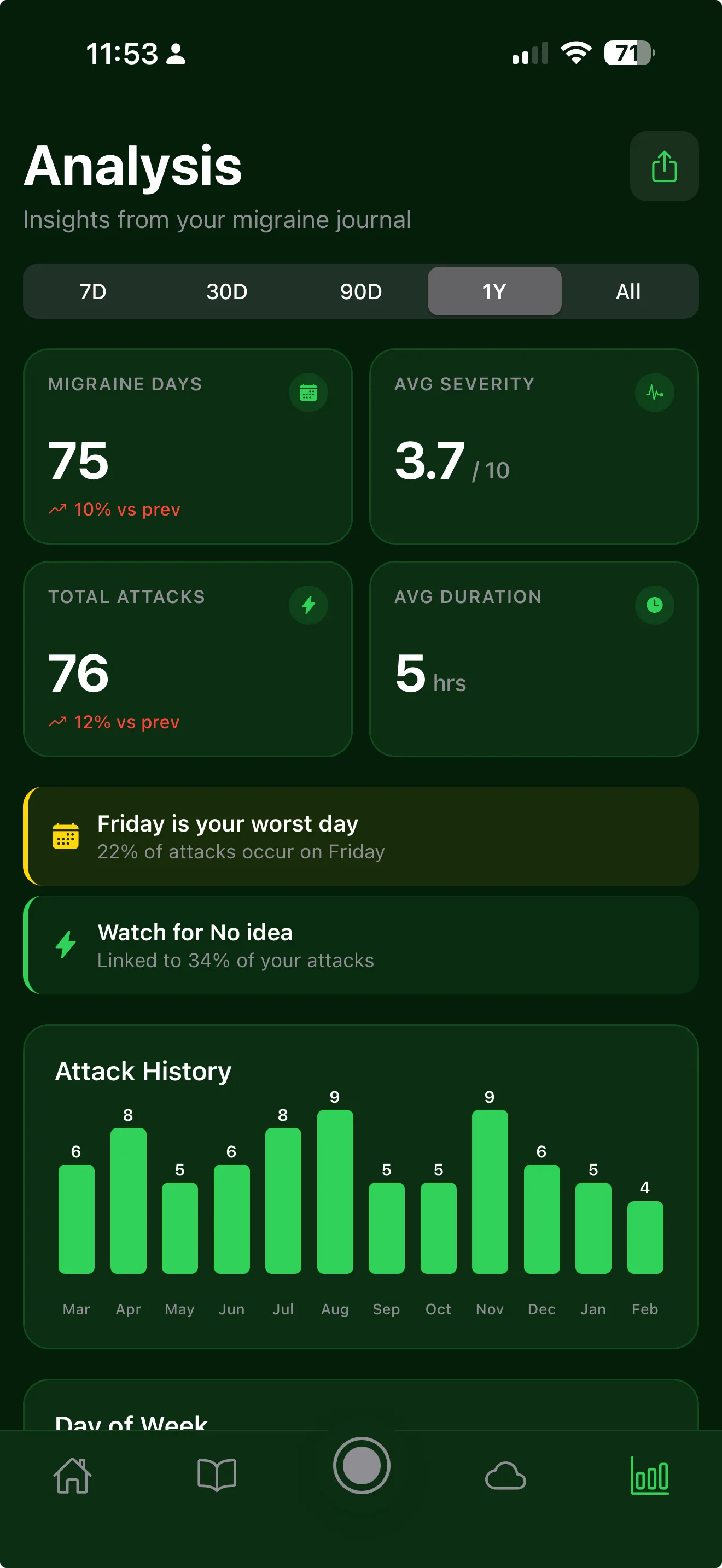
Instead of summarising 90 days of complex symptom history from memory in a 15-minute appointment, bring a structured clinical PDF report generated automatically from your symptom log, with visual charts, timelines, and trigger summaries.
- One-tap PDF export with visual charts and timelines
- Symptom frequency, severity, and trigger summaries
- Shareable format for specialist referrals
Every Migraine Symptom, Tracked
Migraine Trail captures the full spectrum, before, during, and after every attack.
Visual Aura
Zigzag lines, blind spots, and flashing lights are hallmarks of migraine with aura. Consistent aura tracking helps confirm your migraine subtype and directly influences which medications are appropriate for you.
Throbbing Head Pain
Pulsating, one-sided pain that worsens with movement. Logging pain location, left, right, bilateral, or behind the eye, alongside intensity on every entry creates the severity trend data neurologists actually need.
Nausea & Vomiting
Affects up to 80% of migraineurs. Nausea severity and its timing relative to head pain onset is clinically significant, it directly influences which acute treatment options your doctor recommends.
Photophobia (Light Sensitivity)
One of the most disabling migraine symptoms. Tracking photophobia severity over time reveals how it changes with treatment and helps quantify the true disability burden of your attacks beyond pain alone.
Phonophobia (Sound Sensitivity)
Noise intolerance during attacks. Logging phonophobia consistently can reveal whether it correlates with specific triggers or intensifies under particular conditions, information that shapes your management plan.
Postdrome (Migraine Hangover)
Exhaustion, brain fog, and mood changes following an attack, sometimes as disabling as the headache itself. Postdrome duration contributes to your total migraine burden and monthly disability score.
Cognitive Symptoms
Word-finding difficulty, memory gaps, and slowed thinking during and after attacks. Often underreported but highly relevant to quality-of-life assessments and discussions with your neurologist about disability impact.
Weather Sensitivity
Barometric pressure changes trigger attacks in a significant proportion of migraineurs. Migraine Trail logs real-time weather data alongside every entry automatically, no extra steps needed to track this correlation.
Understanding the Full Picture: Why Symptoms Are Just the Start
Your symptoms tell you what's happening. Your triggers tell you why, and how to prevent it.
Migraine is one of the most complex neurological conditions to manage precisely because no two people experience it the same way. The same attack can look completely different in two patients, one with severe visual aura and mild head pain, another with no aura but debilitating nausea and phonophobia. This variation is why generic advice rarely helps, and why personalised symptom tracking over time is the single most effective tool you have outside of medication.
Symptoms also change. What starts as episodic migraine can evolve into chronic migraine over months or years, often so gradually that neither patient nor doctor notices the shift without data. Regular symptom logging is how you catch this early, when treatment adjustments are most effective. It's also how you prove to your insurer or employer that your condition is real, consistent, and disabling.
The Connection Between Symptoms and Triggers
Symptoms and triggers are closely linked. Prodrome symptoms, yawning, food cravings, neck stiffness, mood changes, appear hours before head pain and often indicate which trigger combination is active. Tracking these early warning signs teaches you to recognise your personal prodrome pattern, which gives you a window to take abortive medication before full-blown pain sets in. Our guide to barometric pressure and migraine prediction covers one of the most common trigger-symptom pathways in detail.
Understanding aura is equally important. Migraine with aura carries different treatment considerations than migraine without, certain medications, including combined hormonal contraceptives, carry higher risk for people who experience aura with their attacks. Our complete guide to migraine with aura explains what different aura types mean and how they affect your treatment options.
How AI Makes Symptom Tracking Manageable
Manually tracking 8 categories of symptoms across every attack is an overwhelming task, which is why most people give up before the data becomes useful. Migraine Trail removes this burden entirely. You describe your attack in plain language by voice, and the AI extracts all symptom categories automatically. The longer you log, the more accurate your personal trigger and symptom profile becomes. Most users start seeing meaningful patterns within 6–8 weeks, and those patterns become the foundation for smarter conversations with their neurologist and more targeted lifestyle adjustments.
Migraine Symptom Tracking Questions
Common questions about how to track symptoms and identify patterns effectively.
How do I track my migraine triggers effectively?
The key is logging consistently and capturing potential triggers alongside every attack, not just the pain data. Log sleep quality, stress level, weather conditions, foods eaten, hydration, and hormonal cycle alongside attack details. Over 6–8 weeks, patterns emerge. Migraine Trail's AI does this cross-referencing automatically from your voice entries.
How long does it take to identify my migraine patterns?
Identifying reliable patterns typically requires 8–12 weeks of consistent data. Look for correlations between attacks and specific days of the week, barometric pressure drops, sleep duration changes, hormonal cycle timing, or dietary habits. Migraine Trail's AI pattern engine analyzes your entries continuously and flags these correlations, no manual analysis required.
Can tracking symptoms help reduce migraine frequency?
Yes, once you identify your top controllable triggers, targeted lifestyle adjustments can meaningfully reduce attack frequency. Many users report 20–40% fewer attacks after 3 months of consistent tracking combined with trigger avoidance. The key is having reliable data to act on, not guesswork.
What symptoms should I log during every migraine?
Every entry should capture: pain intensity and location, presence of aura (visual, sensory, or motor), nausea and vomiting, light sensitivity, sound sensitivity, any cognitive symptoms, medications taken and their timing, and potential triggers noticed that day. Migraine Trail captures all of this from a short voice description.
Start Tracking. Start Understanding.
The best migraine tracker app is the one that does the work for you. Log by voice, get AI pattern analysis, and bring real data to every appointment, all free.
Download Migraine Trail FreeRelated: Migraine Diary App · Trigger Tracking