The Evolution of Migraine Tracking
For decades, the standard advice for anyone suffering from chronic headaches has been simple: "keep a migraine diary." Historically, this meant relying on paper notebooks, calendars, or even spreadsheets to manually record dates, times, pain levels, and suspected triggers. While tracking is essential for effective migraine management and medical diagnosis, the way we track has fundamentally changed. Today, an AI migraine tracker app offers sophisticated capabilities that manual journals simply cannot match.
But is migrating to a digital platform always the right choice? Below, we break down the pros and cons of an AI Migraine Tracker App vs Manual Journal, helping you choose the best system to manage your health.
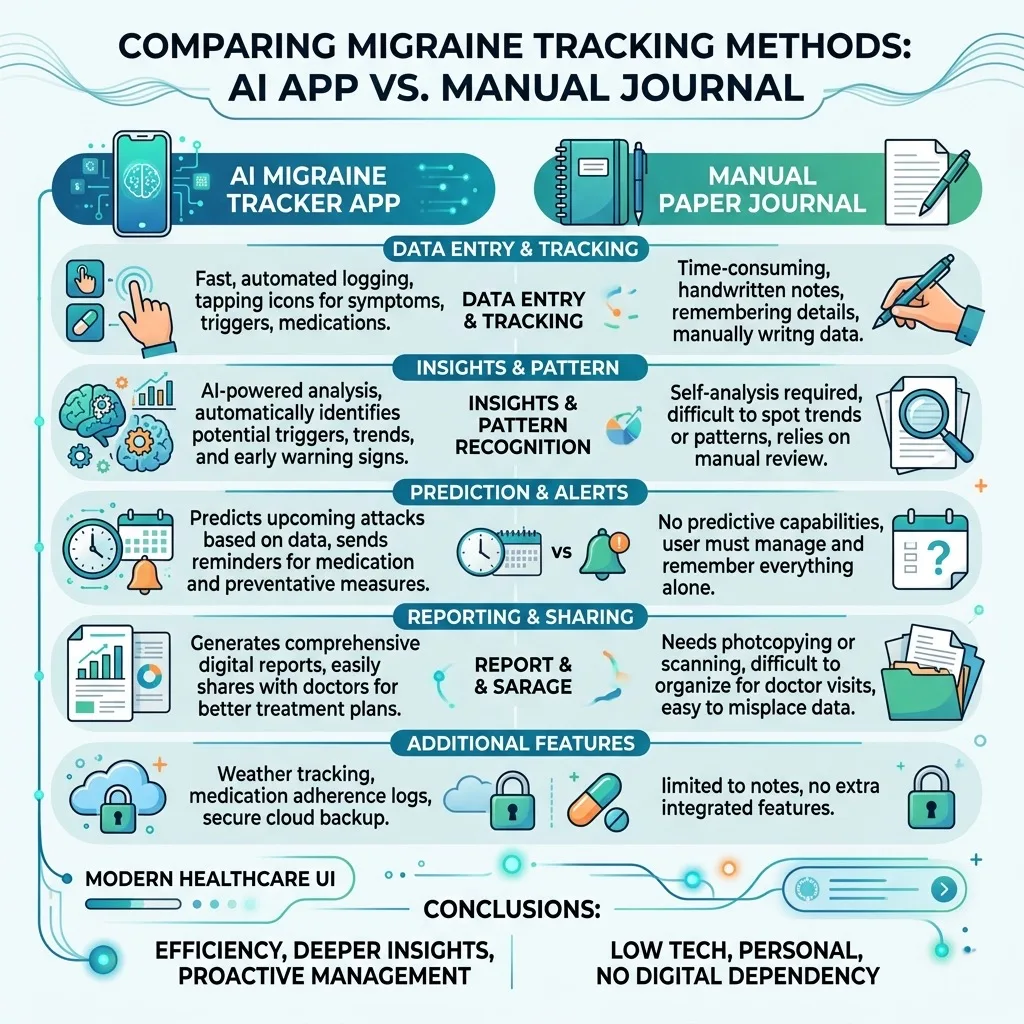
The Traditional Manual Journal
The manual paper journal is the classic method for headache tracking. It relies on pen and paper, often using a templated grid to check off symptoms and write qualitative notes about an attack.
Pros of Manual Journals
- Zero Distraction: Writing on paper eliminates the need to stare at a bright smartphone screen—a significant advantage when you are experiencing severe photophobia (light sensitivity) during an attack.
- Infinite Customization: A blank piece of paper allows you to write notes in whatever format you prefer, drawing diagrams of pain locations or adding extensive personal journals alongside your clinical data.
- No Technical Dependencies: Paper doesn't run out of battery, require an internet connection, or experience software bugs. It is always accessible as long as you have a pen.
Cons of Manual Journals
- Labor-Intensive: Filling out a detailed log requires physical effort and strong cognitive focus. During a debilitating attack, finding a notebook and writing neatly is often impossible.
- Difficult to Analyze: Unless you love crunching numbers, it is nearly impossible to manually spot complex patterns correlating your attacks to subtle changes in weather, sleep, or dietary habits over a six-month period.
- Hard to Share: Bringing a messy, handwritten notebook to a highly constrained 15-minute neurologist appointment guarantees that your doctor won't be able to effectively process your data.
- Prone to Loss: If you spill water on your journal or leave it on a bus, months or years of crucial health data vanish instantly.
The AI Migraine Tracker App
Digital health apps, specifically AI-powered trackers like Migraine Trail, leverage modern technology to simplify data entry and maximize the clinical value of the information you collect.
Pros of AI Apps
- Effortless Logging via Voice: The biggest complaint about digital apps is screen time during attacks. Overcoming this, modern AI trackers feature voice logging. With a simple verbal command, you can describe your symptoms with your eyes closed in a dark room. The AI automatically parses your speech into structured data (pain intensity, symptoms, medications).
- Automated Pattern Recognition: An AI tracker doesn't just store your data; it actively analyzes it. By correlating your recorded attacks with environmental data, an AI app can automatically detect non-obvious triggers—such as a specific drop in barometric pressure that precedes your migraines by 24 hours.
- Predictive Alerts: By understanding your historical patterns and monitoring real-time environmental factors, an AI app can forecast periods of high risk and send proactive alerts, allowing you to take preventative medication before an attack fully manifests.
- Clinical Reporting: AI apps automatically generate standardized, professional-grade PDF reports summarizing your attack frequency, medication adherence, and trigger correlations. These reports are perfectly formatted for neurologist consultations, saving time and ensuring accurate medical communication.
- Secure Cloud Backup: Your health data is securely encrypted and backed up to the cloud. You can sync it across multiple devices and easily recover it if you lose your phone. Privacy standards ensure your sensitive medical information is protected.
Cons of AI Apps
- Learning Curve: Transitioning to a new digital system requires familiarizing yourself with the app's interface and settings.
- Digital Dependency: Requires a charged smartphone.
- Screen Exposure (If Not Using Voice): Without voice logging features, looking at a brightly lit app screen can exacerbate photophobia during a severe migraine episode.
Head-to-Head Comparison
| Feature | Manual Paper Journal | AI Migraine Tracker App | | :--- | :--- | :--- | | Data Entry Effort | High (must write out details) | Low (tap icons or use voice logging) | | Pattern Discovery | Low (requires self-analysis) | High (automated AI correlation) | | Weather & Environmental Tracking | None (unless manually researched and logged) | Automatic (integrated with localized weather APIs) | | Doctor Communication | Poor (messy pages to review) | Excellent (automated, structured PDF reports) | | Portability | Requires carrying a physical book | Always in your pocket on your smartphone |
Why Migraine Trail Provides the Best of Both Worlds
The Migraine Trail app bridges the gap between the simplicity of a manual journal and the power of artificial intelligence. If the primary reason you avoid digital tracking is the need to look at a bright screen, Migraine Trail’s "Dark Room First" approach solves this completely.
With advanced voice logging, you simply speak into your phone—"I have a level 8 headache, throbbing on the left side, starting an hour ago. I just took my sumatriptan." The AI parses your natural language, automatically tags your symptoms, calculates timestamps, and categorizes the medication. You get all the predictive power, pattern recognition, and professional doctor reports of a digital app, without ever having to expose your sensitive eyes to blue light during an attack.
Conclusion: Making the Switch
While a manual journal is better than not tracking at all, it simply cannot provide the actionable insights required for modern, effective migraine management. For individuals who experience chronic migraines, the ability to automatically discover hidden triggers and generate clinical reports for physicians makes an AI migraine tracker app the unequivocally superior choice.
By upgrading to an AI-powered system, you offload the burden of analysis to technology, allowing you to focus on what truly matters: treatment, recovery, and reclaiming your life from chronic pain.