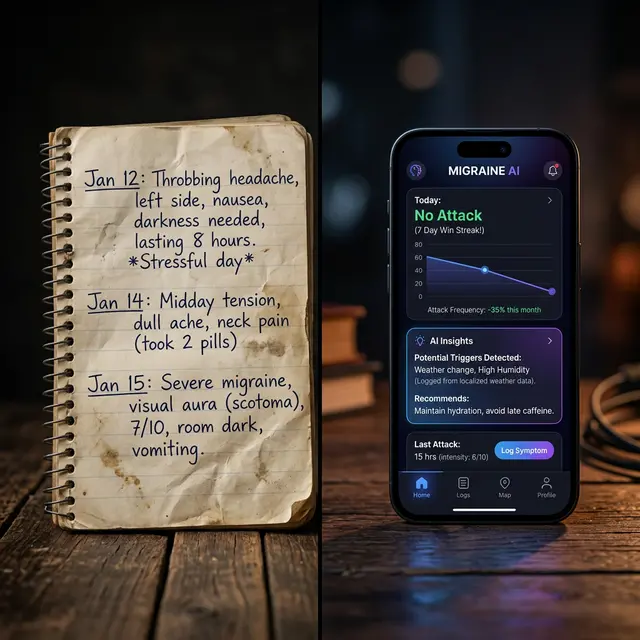
If you have been managing chronic migraines for any length of time, a doctor has almost certainly told you to "keep a diary." For most people, that meant grabbing a notebook and jotting down the date, pain level, and maybe a suspected trigger. Paper diaries have served as the default headache diary for decades.
But the question is no longer whether you should track your migraines. The question is how. A modern migraine tracker app offers capabilities that paper simply cannot replicate. In this head-to-head comparison, we will examine the honest strengths of each method, and explain why digital tracking is the clear winner for anyone serious about migraine relief.
The Case for Paper
Let's give credit where it is due. A paper diary has real advantages:
- Zero learning curve. You open a notebook and write. There is no app to download, no account to create, and no settings to configure.
- No technology required. For patients who are not comfortable with smartphones, a paper notebook removes the tech barrier entirely.
- Tactile satisfaction. Some people genuinely process information better when they physically write it down.
- No subscription fees. A $3 notebook from the drugstore lasts for months.
For someone who experiences infrequent, mild headaches, a simple paper log might be perfectly adequate. However, the moment you are dealing with chronic migraines, the limitations of paper become painfully obvious.
The Case for Digital
A dedicated migraine tracker app does not just record your data. It actively works with your data to drive better migraine management. Here is what digital tracking unlocks:
Automatic Weather Correlation
Barometric pressure changes are one of the most common and most difficult to track migraine triggers. With paper, you would need to manually look up local pressure readings every single time you logged an attack. A digital app does this automatically. The moment you log an entry, your app pulls the exact atmospheric conditions from that timestamp and cross-references them against your history. Over weeks, the app definitively tells you whether weather is one of your personal triggers. Read our deep dive into barometric pressure and migraines for the full science.
AI-Powered Pattern Recognition
A notebook cannot analyze itself. You can stare at 90 days of handwritten entries and still miss the fact that your attacks cluster on days when you slept under 6 hours and skipped breakfast. A digital tracker runs multi-variable analysis across your entire dataset and surfaces correlations a human eye would never catch. This is how you truly keep a trigger log with clinical precision.
Voice Logging During Attacks
Here is the brutal truth about paper diaries: when you are in the middle of a severe migraine, you are not going to sit up, turn on a light, find your notebook, and write legibly. You are lying in a dark room with your eyes shut. A digital app with voice logging lets you whisper your symptoms in 10 seconds without ever opening your eyes. The AI structures your natural speech into clinical data points. Read more about why voice logging changes everything.
Doctor-Ready Reports
Neurologists have roughly 15 minutes per appointment. Handing your doctor a messy notebook full of shorthand and crossed-out entries is not an effective use of that time. A daily headache log exports your data as a clean, structured PDF with calendar heatmaps, severity charts, and trigger breakdowns. This single feature can transform the quality of your medical consultations.
Data Visualizations and Trends
Paper gives you a list. An app gives you a picture. Interactive charts showing your attack frequency over months, medication efficacy percentages, and trigger distribution pie charts allow you to spot trends at a glance. Numbers in a notebook cannot compete with a visual dashboard purpose-built for migraine management.
Head-to-Head Comparison
| Feature | Paper Diary | Migraine Tracker App | |---|---|---| | Speed of logging | 2-5 minutes (writing) | 10 seconds (voice log) | | Accuracy | Relies on memory, often delayed | Real-time logging with auto-timestamps | | Weather tracking | Manual lookup required | Automatic barometric pressure capture | | Pattern recognition | You read your own notes | AI cross-references multi-variable data | | Portability | Must carry the notebook | Always on your phone | | Sharing with doctors | Hand over a notebook | One-tap PDF export | | Medication tracking | Tally marks at best | Efficacy scores and overuse warnings | | Data backup | Can be lost, damaged, or destroyed | Cloud-synced and always recoverable |
The Verdict: Digital Wins for Serious Migraine Management
Paper diaries are better than nothing. If you have never tracked your migraines at all, even a simple notebook is a step in the right direction.
But if you live with chronic migraines and are genuinely pursuing migraine relief, a paper diary is like bringing a spoon to a sword fight. The automatic weather integration, AI pattern detection, frictionless voice logging, and clinical-grade reporting in a modern migraine tracker app provide an overwhelming advantage.
The data you collect is only as useful as the insights you can extract from it. Paper gives you raw data. A digital tracker gives you answers.
Ready to make the switch? Download Migraine Trail on the App Store and experience the difference for yourself. You can be up and running in under two minutes with our step-by-step onboarding guide.
Keep Reading
- How to Track Migraines Effectively with a Mobile App
- Top 10 Migraine Triggers Backed by Data
- Migraine Tracker Apps: Features You Can't Live Without
- How to Analyze Migraine Patterns with App Data
- How to Present Migraine Data to Your Neurologist
Get Migraine Trail free on the App Store and start tracking smarter today.