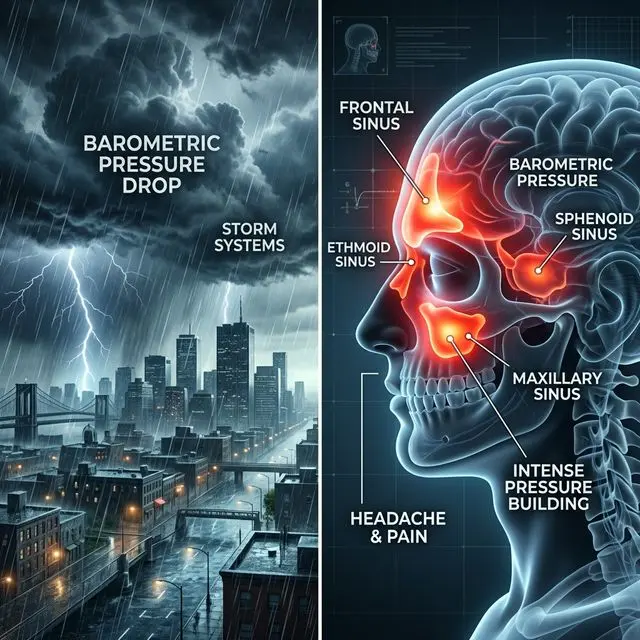
Key Takeaway: Barometric pressure drops cause migraines by creating an imbalance between the air pressure outside the body and the pressure inside the sinus cavities and inner ear. This imbalance physically irritates the trigeminal nerve, triggering neuro-inflammation and pain in susceptible individuals. Digital migraine trackers can automatically correlate attacks with pressure changes and even forecast future risk based on weather data.
If you have ever felt a pounding headache manifest exactly 12 hours before a major thunderstorm hit your city, you are not crazy. You are not a human psychic. You are one of millions of migraineurs suffering from barometric pressure sensitivity. It regularly tops the list of the top 10 migraine triggers backed by data.
Understanding the mechanical science behind this phenomenon is the first step to mitigating it. And leveraging a modern migraine tracker app to predict it is the final step. Here is exactly why weather causes migraines.
How Does Barometric Pressure Trigger Migraines?
Barometric (or atmospheric) pressure is the physical weight of the air pushing down on the earth. When a high-pressure system is in place, the weather is typically clear and calm. When a low-pressure system moves in, it usually brings clouds, wind, and rain.
Your brain is encased in a rigid skull, but your inner ear and sinus cavities contain air. When the barometric pressure drops rapidly (the weight of the outside air decreases), the air inside your sinuses and ears expands relative to the outside environment.
This rapid expansion pushes physically against your trigeminal nerve, the massive facial nerve responsible for transmitting sensory information. For individuals with hyper-reactive migraine brains, this physical pressure is interpreted as traumatic pain, initiating a cascade of neuro-inflammation that results in a severe attack. Want to dig deeper? Read our piece on how temperature drops cause vascular headaches.
Why Can't Paper Journals Identify Weather-Related Migraine Triggers?
If you are using a standard paper notepad to spot your trigger patterns, identifying weather patterns is exhausting. You would have to manually find historical weather data for your specific ZIP code and write it down next to your pain scores every day.
Because pressure drops often occur 12 to 24 hours before the rain actually starts falling, patients using paper journals frequently misdiagnose their trigger, blaming a stressor or food item they consumed that morning. This is exactly why manual journals fail versus automated trackers.
How Can a Digital Migraine Tracker Predict Weather-Triggered Attacks?
This is where a Migraine Trail becomes clinically necessary. A sophisticated headache journal like Migraine Trail continuously pulls live, invisible barometric pressure readings via GPS APIs.
Not only does it automatically tag your historical attacks with the exact pressure variance that occurred 24 hours prior, but it provides a 14-day migraine prediction forecast. Read our full review of the weather migraine prediction tool for details. Weather integration is absolutely a feature you cannot live without.
What Can You Do When a Pressure Drop Is Forecasted?
If your migraine journal app alerts you that a severe barometric pressure drop is scheduled for Thursday afternoon, you can engage in proactive prevention. You can choose to hydrate aggressively on Wednesday, ensure you get a full 8 hours of sleep to keep your "Trigger Threshold" high, or even take a preemptive preventative medication as advised by your neurologist.
You cannot control the weather, but with the right migraine management strategy and data tracking, you can control how your body reacts to it. For those living with chronic migraines, this proactive approach is the most reliable path to migraine relief.
Frequently Asked Questions
Q: How far in advance can barometric pressure changes trigger a migraine?
Pressure drops often occur 12 to 24 hours before the associated rain or storm arrives. Many migraine sufferers report headaches beginning in this window before any visible weather change, which is why automated pressure tracking is more reliable than manual observation.
Q: What barometric pressure level is considered a migraine risk?
There is no single universal threshold. Research suggests that rapid drops of 5-10 millibars (hectopascals) over a short period correlate with increased migraine incidence. Individual sensitivity varies, which is why personal tracking over time is important for establishing your own patterns.
Q: Can you prevent a barometric pressure migraine?
While you cannot stop the weather from changing, proactive steps can reduce the severity or likelihood of an attack. Common strategies include staying well hydrated, maintaining consistent sleep, avoiding other known triggers during high-risk periods, and taking preventative medication as directed by a neurologist.
Q: Why do some people get weather migraines and others do not?
People with migraine have hyper-reactive nervous systems that are more sensitive to environmental changes. The trigeminal nerve and sinus cavity pressure response vary between individuals, which is why barometric pressure is a significant trigger for some migraine sufferers but not for others.
Prepare for the next storm with our cold front migraine emergency kit, and follow our step-by-step app guide to get started.