For centuries, people living with severe chronic headaches have insisted that they can "feel it in their bones" right before a massive thunderstorm hits. Historically, the medical community often dismissed these claims as old wives' tales or confirmation bias. However, modern neurology and meteorology have definitively proven what migraineurs have known all along: the weather is an undeniable, powerful, and scientifically measurable trigger for neurological pain. For a comprehensive look at the mechanisms involved, see our deep dive into how weather affects migraines.
If you find yourself repeatedly suffering from intense migraines precisely when the seasons change, when a hurricane sits off the coast, or when a massive cold front sweeps across the continent, you are not imagining it - and with climate change intensifying these weather patterns, understanding this connection has never been more important. You are experiencing the profound physiological effects of a drop in barometric pressure. The challenge, however, is that you cannot control the weather. You cannot stop the storm. But by understanding the intricate science behind these atmospheric shifts and leveraging a sophisticated migraine journal to map them, you can transition from a helpless victim to an empowered, proactive patient.
The Invisible Weight: Understanding Barometric Pressure
The core of weather-induced migraines lies in an invisible force: barometric (or atmospheric) pressure. Imagine the entire atmosphere of the Earth as a giant ocean of air. Like water, this air has physical weight and mass, constantly pressing down on everything on the planet's surface, including your body.
During calm, sunny, and stable weather, the pressure is generally "high." The air inside your body-specifically within your intricate sinus cavities, your inner ear, and the fluid surrounding your brain-is perfectly equalized with the heavy pressure pushing from the outside. You feel nothing out of the ordinary.
However, when a significant weather event approaches-such as a severe thunderstorm, a blizzard, or a high-wind front-the atmospheric pressure typically drops rapidly. This creates a state of "low pressure" in the environment. This drop means that the air pressing against you is suddenly lighter and less dense than the air trapped inside your head.
The Neurological Domino Effect
This seemingly microscopic disparity in pressure has devastating consequences for a hypersensitive nervous system. As the outside pressure drops, the air inside your sinus cavities attempts to expand to equalize with the newly thin environment.
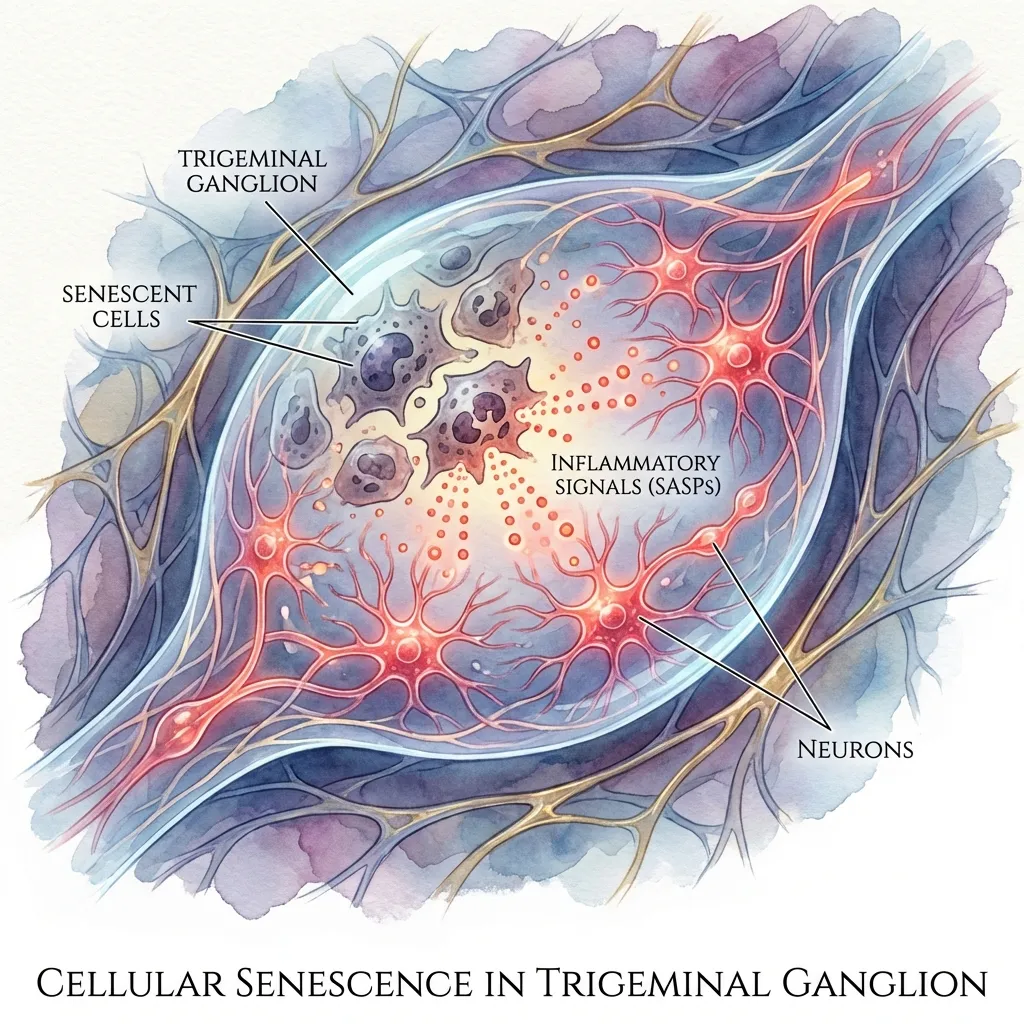
For the average person, this micro-expansion might cause a slight popping in the ears or a fleeting sense of fullness. But for an individual with the underlying neurobiology of a migraine, it acts as a massive physiological insult. The expansion pushes against delicate blood vessels and surrounding tissues. The trigeminal nerve, the massive cranial nerve responsible for sensation in the face and head, is notoriously hyper-reactive in migraineurs. It detects this microscopic swelling not as a harmless weather event, but as a critical threat or injury.
In a fraction of a second, the trigeminal nerve begins misfiring. It releases an overwhelming cascade of inflammatory neuropeptides, including Calcitonin Gene-Related Peptide (CGRP), directly into the meninges (the protective layers surrounding the brain). This massive chemical dump causes immense neurogenic inflammation, vasodilation (the painful widening of blood vessels), and the excruciating, throbbing pain that defines a classic migraine attack.
Moving from Anecdote to Data: The Need for Mapping
Understanding the mechanism is fascinating, but it doesn’t stop the pain. The critical step in managing weather triggers is translating this general science into your specific, deeply personal data profile. This is why a generalized notebook is useless, and why a highly advanced digital migraine journal is absolutely vital.
You must map your specific sensitivities. Not everyone reacts to the same drop. Does a 5 hectopascal (hPa) drop over 12 hours trigger you, or does it require a rapid 10 hPa plummet in under 4 hours? Do sudden spikes in humidity combined with high temperatures act as an independent trigger?
A modern migraine journal doesn't require you to manually check the Weather Channel. Instead, it utilizes comprehensive, real-time API integrations. It silently runs in the background of your smartphone, pulling highly accurate, geographic-specific meteorological data precisely when you log an attack. Over a period of three to six months, the software’s algorithms cross-reference your pain events with the invisible atmospheric data.
The Power of Anticipation
Once your journal maps your individual threshold for atmospheric shifts, the paradigm of your treatment changes. You unlock the power of anticipation. Leading migraine trackers in 2026 feature predictive alerts. If the algorithm knows you are highly vulnerable to a 10 hPa drop, and the forecast predicts one arriving on Thursday afternoon, your phone will warn you on Wednesday.
This early warning system gives you a defensive window. While you still cannot stop the barometric pressure from plummeting, you can profoundly alter your body's readiness for the impact. You can ruthlessly eliminate all other compounding triggers: you drink an extra liter of water, you ensure a strict eight hours of sleep, you aggressively avoid dietary triggers like aged cheeses or alcohol, and you cancel high-stress meetings. By lowering your overall physiological stress, you raise your neurological threshold. Often, this strategic preparation is enough to prevent the weather alone from pushing you over the edge into a full-blown migraine.
The science of weather triggers is complex, but the solution is elegantly simple: map the shifts, predict the drop, and act defensively before the storm ever breaks.
Start mapping your weather sensitivity with the the Migraine Trail app, available free that automatically logs barometric pressure data alongside your attacks, helping you track migraine triggers and get ahead of the next storm.